
Walk into any gold souk in Dubai, and you will see price boards listing gold rates for 24K, 22K, 21K, and 18K side by side. Most buyers glance at the numbers, pick a piece they like, and pay without fully understanding what those karat values actually mean.
That is a costly mistake.
The difference between 22k vs 24k gold goes far beyond price. It shapes how the gold performs as jewellery, how it holds up under daily wear, how lenders evaluate it for a gold loan, and whether it truly serves your investment goals. Whether you are buying gold bars, gold coins, or planning to sell existing gold jewellery you own, understanding this distinction before you act could save you real money.
Let us walk through everything you need to know.
What is gold purity, and how is it measured?
Gold purity refers to the proportion of pure gold in a piece, relative to the other metals present in it. Measuring gold purity is done through the karat system, where pure gold is divided into 24 equal parts.
- 24K gold = 24 out of 24 parts are gold = 99.9% pure gold
- 22K gold = 22 out of 24 parts are gold = 91.67% pure gold
So when you buy 22K gold jewellery, you are buying a piece that is 91.67% gold. The remaining 8.33% consists of other metals, typically copper, silver, or zinc, mixed in to add strength and durability.
The karat value is stamped directly onto gold articles as a hallmark. Look for “999” or “999.9” on 24 carat gold pieces, and “916” on 22K items. These markings are your assurance of gold quality and authenticity. A hallmark certification is essential whenever you are purchasing gold.
Understanding 24K gold: The purest form
24K gold is the purest form of gold you can buy commercially. With 99.9% gold content and virtually no alloy metals, it carries the highest intrinsic value per gram of any karat grade.
Its colour is the richest, most vivid yellow you will see, a deep, warm tone that is unmistakably gold. This is what pure gold looks like in its natural, refined state.
Where 24K gold is used
Because of its high purity and softness, 24K gold is not typically used for everyday jewellery. Pure gold is highly malleable, and it bends, dents, and scratches far too easily to withstand daily wear. Instead, 24-carat gold is most commonly found in:
- Gold bars — used for investment and wealth storage
- Gold coins — minted by governments and refineries globally
- Medical equipment — gold’s conductivity and resistance to corrosion make it valuable in precision electronics and dentistry
- Ceremonial pieces — where display and purity matter more than durability
For investors seeking a pure investment asset, 24K gold is the straightforward choice. Its value is directly tied to the market price of gold, with no alloy metals diluting the calculation. When buying gold purely to preserve wealth, 24-carat gold in bar or coin form offers the clearest link to gold’s global market price.
The trade-off: softness
The very quality that makes 24K gold so valuable, and its high purity, is also its key limitation. Because there are no other metals mixed in to harden the structure, 24K gold cannot resist wear the way lower-karat alloys can. It will not hold intricate designs well, and it is not suited for pieces meant to withstand daily wear, ornaments or repeated handling.
Understanding 22K gold: High purity with added strength
22K gold is 91.67% pure gold, with the remaining 8.33% made up of alloy metals, usually copper and silver, sometimes zinc. This slight change in composition makes a significant practical difference.
The colour of 22K gold remains a rich golden hue, very close to 24K in appearance. Side by side, the difference is subtle to the naked eye. The structural difference, however, is clear.
Why 22K Gold is the standard for gold jewellery
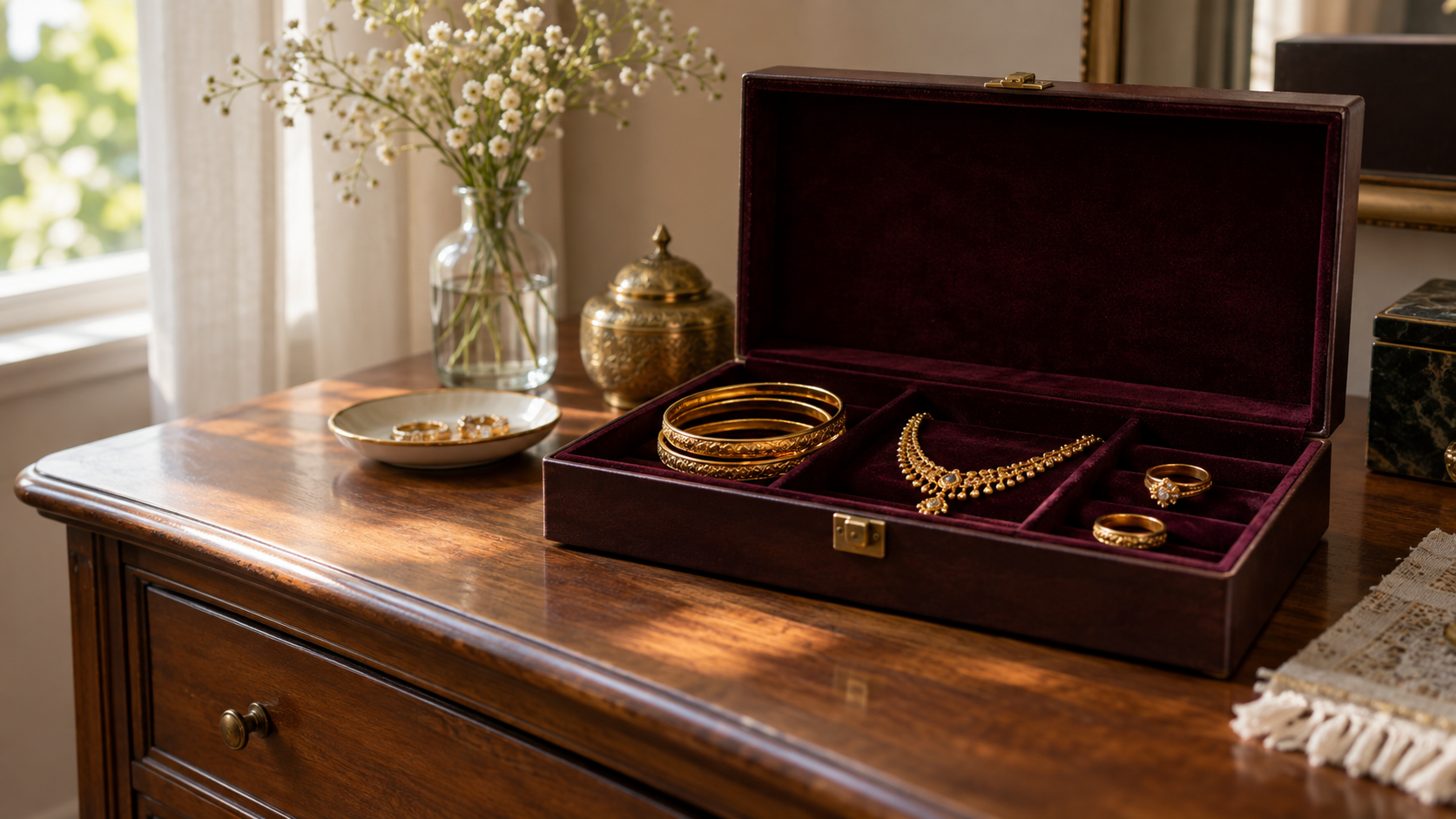
22K gold is the preferred choice for making jewellery across the UAE, India, and the broader Middle East. The metals mixed into 22K gold give artisans the structural integrity they need to craft intricate designs, such as detailed bangles, heavy necklaces, bridal sets that hold their shape and can withstand daily wear.
- Bangles and bracelets — need to hold their circular shape under pressure
- Necklaces and chains — require strength at every link and clasp
- Rings — must resist wear through daily use without bending
- Traditional and ceremonial pieces — where complex design meets long-term durability
If you already own 22K gold jewellery and are considering selling it, its high gold content, 91.67%, means it still carries strong resale value. When you bring 22K pieces to a trusted gold buyer, the payout is calculated based on actual gold content at the prevailing market price.
22K vs 24K Gold: The Major Differences at a Glance
Understanding the difference between 22k and 24k gold comes down to a handful of practical factors. Here is how 22k and 24k gold compare directly:
| Factor | 22K Gold | 24K Gold |
| Gold purity | 91.67% | 99.9% |
| Other metals | 8.33% (copper, silver, zinc) | Negligible |
| Durability | Higher — suitable for jewellery | Lower — too soft for daily wear |
| Colour | Rich golden hue | Deepest, most vivid yellow |
| Primary use | Gold jewellery, everyday jewellery | Gold bars, gold coins, investment |
| Intrinsic value per gram | Slightly lower | Highest |
| Price | Lower per gram | Higher per gram |
| Gold loan value | Good, widely accepted | Higher loan-to-value ratio |
The main difference is purpose. Both 22K and 24K gold have their place. The question is which one fits your goal.
22K vs 24K gold for investment: Which is the better investment?
This is the question most buyers in the UAE ask, and the honest answer depends on what form you are buying and why.
24K Gold: The stronger pure investment asset
For those buying gold purely for investment, in the form of gold bars or gold coins, 24K gold is the cleaner, more direct choice.
24K gold bars and coins carry the highest intrinsic value per gram. There are no alloy metals reducing the gold content, which means the price you pay maps directly onto the global market price of pure gold.
24K gold is also highly liquid and holds global recognition. It trades easily across markets worldwide, accepted by dealers, financial institutions, and refineries without question. In periods of economic uncertainty, physical gold in high-purity bar or coin form has historically been one of the most reliable stores of value.
When you eventually sell 24K gold bars or coins, the transaction is straightforward: weight multiplied by purity multiplied by the current market price.
22K Gold: Still strong, especially for jewellery holders
22K gold carries a slightly lower intrinsic value per gram than 24K because 8.33% of its weight is made up of other metals. However, it remains a high-purity gold with strong market demand, particularly across the Middle East, where 22K gold jewellery is culturally significant and widely traded.
If you already hold 22K gold jewellery, it retains solid resale value. When selling, the payout is based on the actual gold content, which is 91.67% of the total weight, at the day’s prevailing rate. While it will not yield the same per-gram figure as 24K, the high gold content still makes it a meaningful asset worth selling at the right time.
For new investment purchases, however, 24K gold bars and coins remain the stronger option. The absence of alloy metals means higher intrinsic value and a more direct link to the gold market price.
Price difference
The price difference between 22k and 24k gold directly reflects their gold content. As of May 2026, 24K gold in the UAE trades at approximately AED 547 per gram, while 22K gold is priced at around AED 507 per gram. This spread mirrors the difference in purity: you are paying for the amount of pure gold in each gram, not just the physical weight.
What about gold loans?
Gold loans are a practical financial tool widely used in the UAE and across the region. They allow you to borrow money against the value of your gold without selling it. Both 22K and 24K gold are accepted as collateral for a gold loan, but there are key differences worth knowing.
24K gold commands a higher loan-to-value ratio. Because its gold content is higher and its market value per gram is greater, lenders can offer more money against the same weight of 24K gold compared to 22K.
With 22K gold, the loan amount will be slightly lower because the calculation is based on actual gold content, approximately 91.67% of the total weight. Lenders factor in the metals present alongside the gold when determining loan eligibility.
For those who hold gold jewellery for everyday wear but also want the option of borrowing against it, 22K gold remains a practical and widely accepted form of collateral. However, if maximising gold loan value is a priority, 24K gold bars or coins offer a higher intrinsic value per gram and a cleaner calculation for lenders.
Choosing gold in the UAE: Practical guidance
The UAE, particularly Dubai, is one of the world’s most competitive and transparent gold markets. Gold rates are published daily by the Dubai Gold and Jewellery Group and are closely tied to international benchmarks. The UAE has no import duty on gold bars, and VAT on jewellery is a straightforward 5%, making it an attractive environment for both buying gold and investing in gold.
Here is a practical summary of when to choose each:
Choose 24K gold if you:
- Are purchasing gold bars or gold coins purely for investment purposes
- Want the highest intrinsic value per gram
- Plan to store gold and sell it at a later market price
- Need collateral that maximises gold loan eligibility
- Are seeking a pure investment asset with global recognition
Choose 22K gold if you:
- Are buying gold jewellery for daily wear or special occasions
- Want a balance of purity and durability for everyday jewellery
- Are purchasing traditional or bridal pieces in the UAE or the Middle East
- Want to understand what payout to expect when selling gold jewellery
- Are investing in gold that serves a dual purpose as jewellery and an asset
Regardless of which karat you choose, always verify hallmark certification before purchasing gold. For 24K, look for the “999” or “999.9” stamp. For 22K, look for “916.” No hallmark means no guarantee of gold purity.
If you are unsure which option fits your personal preferences and investment goals, speaking with a trusted financial advisor or gold specialist before purchasing gold is always worthwhile.
Final Thoughts
The 22k vs 24k gold debate does not have a single correct answer. It has the right answer for your situation.
24K gold is the purest form of gold, carrying the highest intrinsic value and making it the clear choice for those who are buying gold as a pure investment asset. Gold bars and gold coins in 24K are straightforward, universally valued, and ideal for wealth preservation.
22K gold brings durability to the table. It is the preferred standard for gold jewellery across the UAE and Middle East, a high-purity gold that can withstand daily wear and be crafted into the kind of intricate, rich golden jewellery that has been culturally prized in this region for generations.
Both are genuine, valuable forms of gold. What matters is matching your choice to your purpose.
At Mint Jewels, we help buyers across Dubai, Sharjah, and Abu Dhabi make informed decisions, whether you are purchasing gold bars for investment or gold coins to diversify your portfolio. Visit us in-store or contact our team to get the best advice and prices on 22K and 24K gold today.
Frequently Asked Questions
- Does Mint Jewels sell gold jewellery?
No. Mint Jewels specialises in buying and selling gold bars and gold coins. However, we do buy gold jewellery from customers looking to sell, offering fair, transparent prices based on the current market rate and actual gold content. If you are looking to sell your gold jewellery, Mint Jewels is one of the most trusted gold buyers in the UAE.
- Can I get a gold loan against 22K gold jewellery in the UAE?
Yes, 22K gold jewellery is widely accepted as collateral for a gold loan in the UAE. However, because the gold content is 91.67% rather than 99.9%, lenders will calculate the loan value based on the actual gold content in the piece. 24K gold typically yields a higher loan amount due to its higher purity and intrinsic value per gram.
- How do I verify the gold purity of 22K or 24K gold when buying gold in the UAE?
Always check for a hallmark certification stamped on the piece. For 24 carat gold, look for “999” or “999.9.” For 22K gold, look for “916.” Reputable dealers like Mint Jewels provide certified gold articles with verified purity and never purchase gold without a visible hallmark.
- Why is 24K gold softer than 22K gold?
24K gold is the purest form of gold, nearly 100% pure. In its purest state, gold is a naturally soft, highly malleable metal. The other metals mixed into 22K gold (copper, silver, and sometimes zinc) act as strengthening agents, making the resulting alloy harder and better able to withstand physical stress. The softness of 24K gold makes it unsuitable for everyday jewellery, but ideal for investment-grade gold bars and gold coins.
- Which is the better investment, 22K or 24K gold, during economic uncertainty?
In uncertain economic climates, gold, regardless of karat, has consistently proven its worth as a stable, globally trusted asset. However, 24K gold offers a slight advantage for investment purposes because its higher gold content means a higher intrinsic value per gram and a more straightforward link to the global market price. For investors focused purely on gold as a financial instrument, 24K gold bars or coins are the preferred choice. For those who want gold that also functions as jewellery in culturally significant ways, as is common across the Middle East, 22K gold remains a strong and highly liquid option.